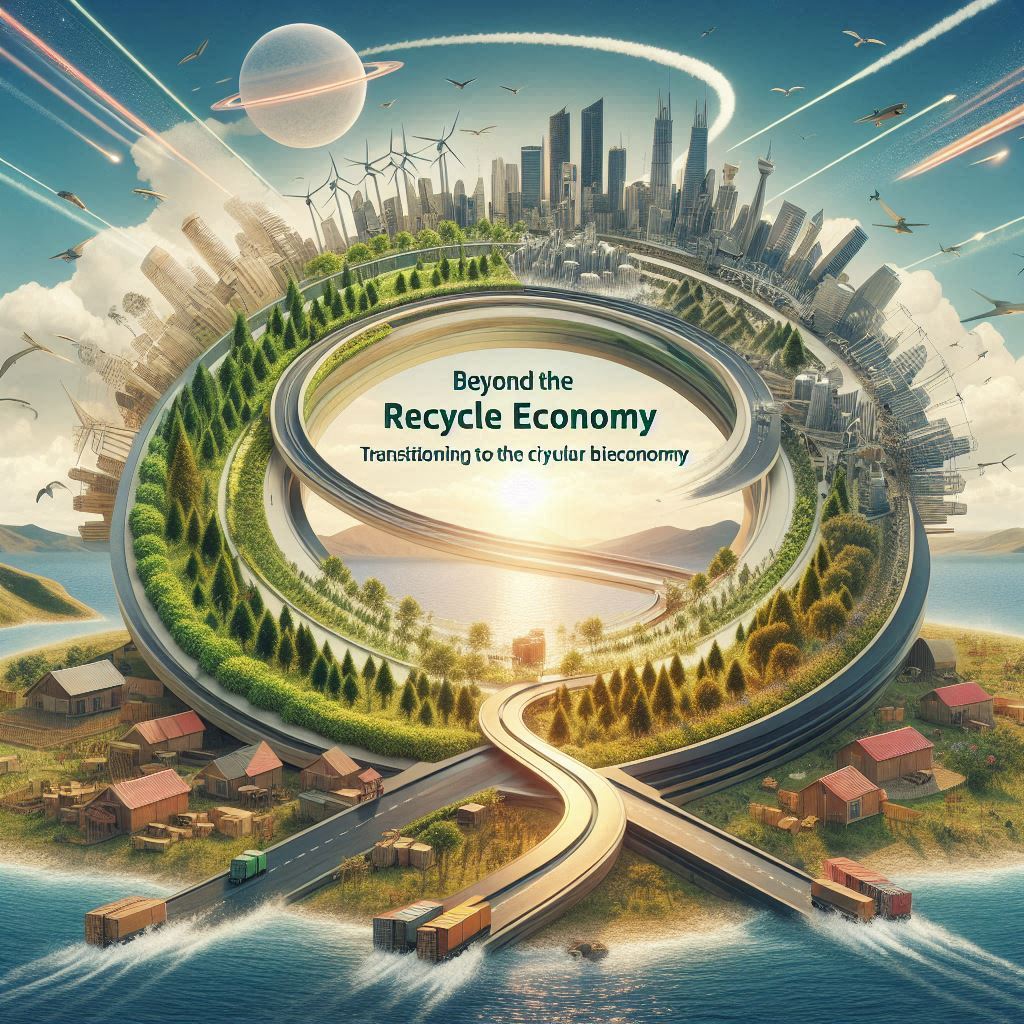
Take-make-forsake material flow model of the linear economies underpinned the twentieth century’s unprecedented industrialization and subsequent urbanization. While this model improved living standards, it consumed vast amounts of fossil fuels and natural resources, causing irreparable damage to the environment and climate. Now, a radical shift towards circular material flow chains is needed to decouple economic activity from resource depletion and environmental burden.
Linear Economy
The Linear Economy is a traditional economic model characterized by a straightforward, one-way flow of materials and resources. It follows a “take-make-forsake” approach, where raw materials are extracted, transformed into products, and ultimately discarded as waste after use. This model underpinned much of the industrialization and urbanization of the twentieth century, significantly improving living standards. However, it relies heavily on the consumption of finite natural resources and generates substantial waste, leading to environmental degradation and climate change. As a result, there is a growing recognition of the need to transition to more sustainable economic models that minimize resource depletion and environmental impact.
Waste Management: It is an integral component of a Linear Economy, distinguishing it from other material flow models. Strategies such as landfilling and long-term storage are employed.
Recycling Economy
Once waste recycling is introduced, the economy begins transitioning towards a Recycling Economy with its take-make-remake model. Products reaching their end-of-life are disassembled, and materials are recycled into new products. However, the benefits of material recycling tend to decrease with each cycle, ultimately reaching a point where recycling becomes environmentally or economically unviable. A Recycling Economy, therefore, cannot provide a truly circular flow of materials, and waste will still be produced.
Circular Bioeconomy
Human civilization has entered an era of constrained natural resources, with increasing restrictions on environmental impact. Meanwhile, a significant portion of the global population is still striving to improve their living standards. Both Linear and Recycling Economic models cannot meet these demands without exacerbating the environmental burden to a critical point. A new model that promotes economic development in harmony with nature is urgently needed. One possible solution to this conundrum is the Circular Bioeconomy.
A Circular Bioeconomy is based on the concept of orycycling, wherein matter is used and reused as a resource. In this model, CO2 and water are the basic resources. They serve as feed for plants, which in turn become the feedstock for manufactured bioproducts, sequestering CO2 into the product. At the end of their life cycle, bioproducts are disassembled into their fundamental matter constituents and remade into new bioproducts. This process, known as matter orycycling, treats any waste as a conglomerate of atoms and molecules, enabling a perpetual make-break cycle.
Biorefinery
The key to transitioning to a Circular Bioeconomy is the biorefinery – a facility that manufactures materials and goods from biomass. The biorefining process utilizes either biochemical or thermochemical routes. Typically, a large biorefinery based on biochemical routes integrates a small thermochemical process to valorize intractable components of the feed. It comprises four main sections: (1) Feedstock treatment and preparation; (2) Biochemical process; (3) Separation and purification; (4) Thermochemical process.
Technological advancements in this decade have led to the production of a wide range of biochemicals with applications in manufacturing industries and Small and Medium Enterprises (SMEs). Adding value to biochemicals will spawn a nascent “green” industry in any local economy. Initially, the critical issues of CO2 emissions and pollution will synergize the value addition of biochemicals with the demands of the energy, construction, transport, and plastic industries.
Orycycling
Orycycling is the locking of matter in a perpetual closed loop. Orycycling of biomaterials is cheaper than producing virgin materials, thus creating an obvious demand from the biomanufacturing industry. This would lead to the creation of new supply chains. Consequently, new operational and service supports will be established for these supply chains and industries. Additionally, there will be new demand for ongoing repair and maintenance support. All these combined would facilitate a seamless transition from a Linear Economy to a Circular Bioeconomy, where bioproducts are manufactured, utilized, repaired, and finally taken apart to manufacture new ones. This transition is primed to generate a large number of manufacturing and servicing jobs in an era where automation and artificial intelligence are threatening existing ones.
Conclusion
Biorefineries, as enablers for biomanufacturing hubs, would act as catalysts for the transition from a Linear Economy to a Circular Bioeconomy. This monumental transition will be led by the manufacturing industry, duly facilitated by government incentives and supported by society. Dramatic technological advancements or innovations are not needed. We have the technology; we need the will.
References
To Cite: Adeerus Ghayan. “Orycycle.” Islamabad: Subagh (2018).
The entire article is taken from Adeerus Ghayan’s book Orycycle.
Amazon Link: https://www.amazon.com/dp/B07MDS544V
Also See
Hexa Framework for Advancing a Linear Economy to an Orycycle Economy

 Adeerus Ghayan