1 Introduction
Biogas is naturally produced from the microbial decomposition of organic waste in an oxygen-free environment. Microorganisms consume the organic matter as a food source and release biogas as a waste product. This process, known as anaerobic digestion, is utilized in systems such as landfills, waste treatment plants, and dedicated biogas plants. These systems also produce a nutrient-rich residue, potentially suitable for use as fertilizer.
The primary constituents of biogas are methane (CH4) and carbon dioxide (CO2), although it can also contain small amounts of other gases like hydrogen sulfide (H2S). The high methane content makes biogas a valuable source of renewable energy; it can be used for heating, electricity generation, and as a fuel for vehicles once impurities are removed.
Industrially, various feedstocks can be used for biogas production, such as agricultural residues, food waste, and animal manure. Recently, there has been interest in using microalgae and macroalgae due to their high growth rates and potential for carbon capture. The choice of feedstock significantly influences the biogas yield and composition, as well as the overall sustainability of the biogas production process.
2 Anaerobic Digestion Process
Anaerobic digestion is a complex biochemical process that involves the breakdown of organic matter in the absence of oxygen. This process is carried out in four stages by a consortium of microorganisms, each contributing to a specific stage of digestion. The process starts with bacterial hydrolysis, where insoluble long-chain polymers of fats, proteins, and carbohydrates are broken down into soluble short-chain polymers. Following hydrolysis, acidogenic bacteria convert the resulting fatty acids, amino acids, and sugars into CO2, hydrogen (H2), ammonia (NH3), and organic acids. In the acetogenesis stage, acetogenic bacteria convert the organic acids produced during acidogenesis into acetic acid. Finally, methanogenic bacteria convert the products of the previous stages into gases, primarily methane. These four stages are detailed below.
2.1 Hydrolysis
The hydrolysis phase involves breaking down complex organic polymers, such as polysaccharides, fats, and proteins, into simpler, soluble molecules like sugars, long-chain fatty acids, and amino acids. This breakdown is facilitated by enzymes like cellulase, amylase, lipase, and protease, which are produced by hydrolytic bacteria. These enzymes catalyze the reaction of water with the long-chain polymers, breaking the bonds and reducing the size of the molecules. This step is vital as it makes the organic material accessible for other bacteria in the subsequent stages.
2.2 Acidogenesis
At this stage, a diverse group of anaerobic bacteria, referred to as acidogens, metabolizes the products of hydrolysis. These bacteria convert sugars, long-chain fatty acids, and amino acids into smaller volatile fatty acids (VFAs), alcohols, CO2, and H2. The production of these compounds is influenced by the H2 concentration in the digester; higher H2 concentrations promote the production of compounds like lactate, ethanol, propionate, and butyrate. Acidogenesis is often the quickest step in the conversion of complex organic matter during liquid-phase digestion.
2.3 Acetogenesis
During this phase, acetogens convert the products of acidogenesis into acetate, CO2, and H2. This step is essential for biogas production, as methanogens, the bacteria that produce methane, cannot directly use the compounds formed during acidogenesis. Acetogens are slow-growing bacteria that depend on a low partial pressure of H2 to obtain energy from acetogenic degradation. They are sensitive to environmental changes and need long periods to adjust to new conditions.
2.4 Methanogenesis
Methanogenesis, the final stage of anaerobic digestion, is where methane is produced. This process is carried out by a group of archaea known as methanogens. Methane is formed through two primary routes: the fermentation of acetic acid, the major product of the acid-forming phase, and the reduction of CO2 with H2. Acetoclastic (or acetophilic) methanogens use acetic acid for this reaction. Only a limited number of compounds can act as substrates in methanogenesis, including acetate, H2, CO2, methanol, and formate. Based on stoichiometric relations, it is estimated that about 70% of methane is produced from acetate, while the remaining 30% is produced from H2 and CO2.
3 One Stage vs Two-Stage Anaerobic Digestion
There are two industrial options for anaerobic digestion: single-stage and two-stage systems. In single-stage systems, the entire process occurs in one tank. In contrast, two-stage systems separate the process into thermophilic and mesophilic stages across two tanks. This thermophilic-mesophilic treatment is more efficient for biogas production compared to conventional single-stage technology.
In the first stage, the reactor operates under thermophilic conditions, with temperatures exceeding 50°C and a retention time of 4 to 6 days. After this stage, the organic matter is transferred to a second tank operating under mesophilic conditions at around 35°C. This stage has a longer retention time, typically between 16 to 20 days. The mesophilic conditions stabilize the digestion process and further degrade organic matter, leading to an overall increase in biogas yield.
4 Industrial Biogas Facility
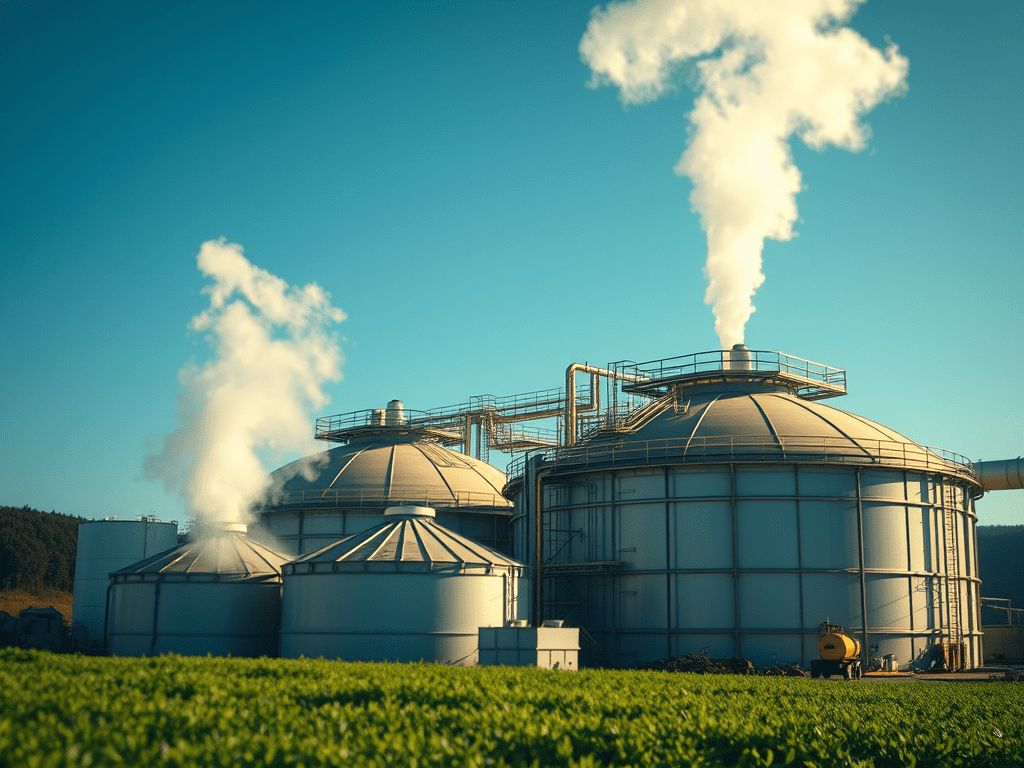
An industrial biogas facility is a sophisticated arrangement of interconnected sections and areas, each essential to the overall process of biogas production. The key components of a typical biogas facility system include:
- Pretreatment System
- Digester System
- Gas System
- Biogas Flaring System
- Heat Exchanger System
- Control System
- Effluent Treatment System
5 Anaerobic Digester Technology
There are multiple anaerobic digester technologies commercially available for producing biogas from waste. Despite the diversity in their design and operational principles, these technologies have several shared objectives.
- Continuously Stirred Tank Reactor
- Covered Lagoon
- Anaerobic Filters
- Fluidized and Expanded Beds
- Upflow Anaerobic Sludge Blanket
- Expanded Granular Sludge Bed (EGSB)
Also See
Technological Evolution of Bioethanol from First to Third Generation

 Adeerus Ghayan