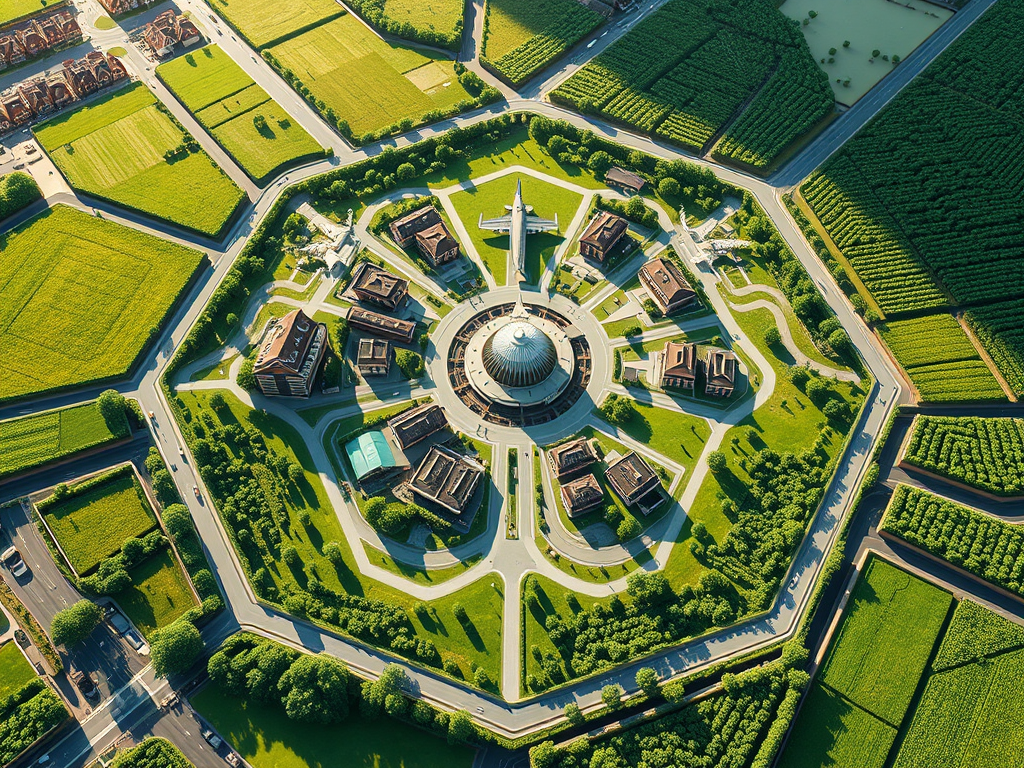
In an era marked by rapid urbanisation and environmental challenges, the concept of an orycycle economy emerges as a beacon of hope for sustainable development. This model prioritises distributed manufacturing and recycling, fostering regional economies where locally consumed products are both produced and recycled within the community. Central to this vision is Hexa City, a proposed urban layout that integrates agricultural practices with urban living, thereby promoting sustainability and resilience.
The Hexagonal Layout
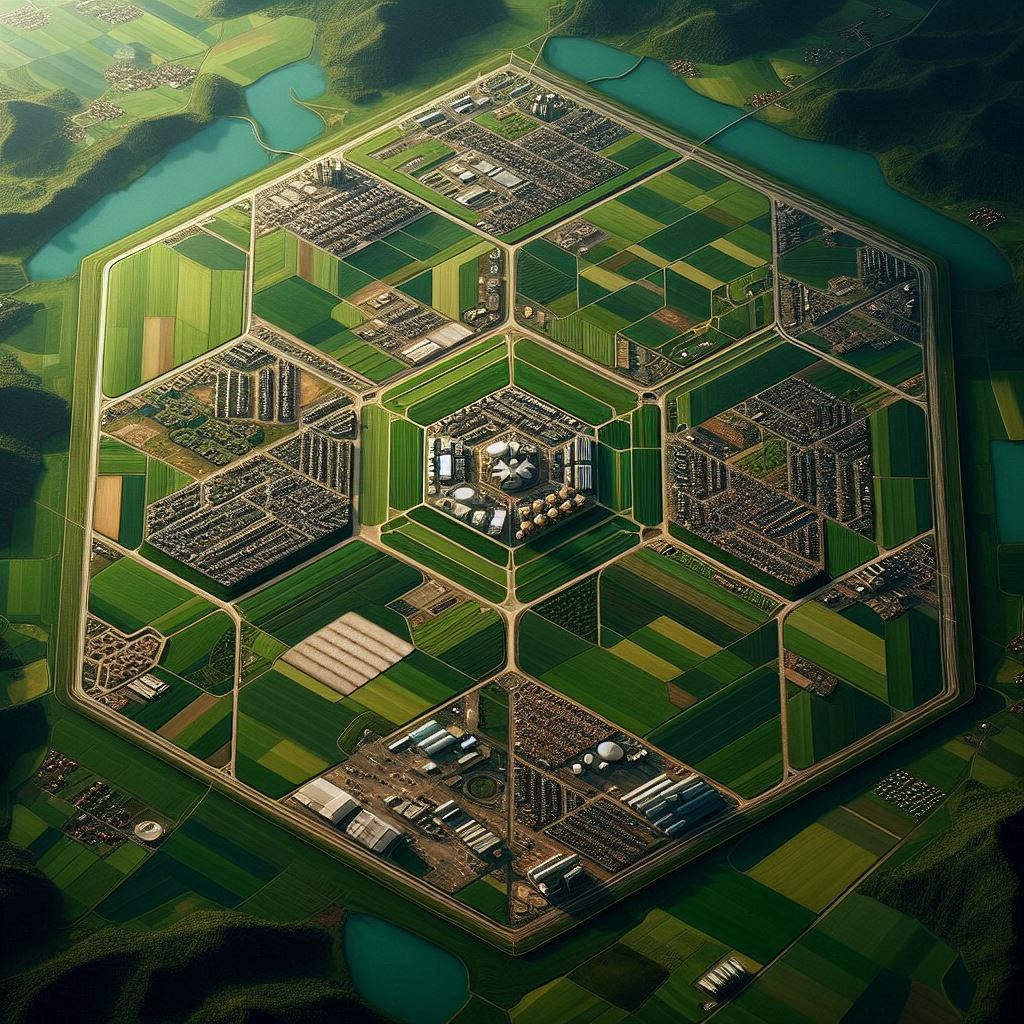
The design of Hexa City is predicated on a geometric layout that not only optimally utilises space but also facilitates efficient transportation and resource distribution. This innovative geometric configuration allows for a harmonious blend of urban and agricultural spaces, creating a vibrant environment that accommodates a population of approximately half a million residents. By interspersing cultivated land with residential and commercial areas, Hexa City promotes local food production and enhances community engagement. The layout encourages walkability and reduces reliance on cars, fostering a sense of connection among residents while ensuring that essential services and green spaces are easily accessible. This thoughtful integration of urban and rural elements exemplifies a forward-thinking approach to sustainable city planning.
- Central Commercial Hub: At the heart of Hexa City lies the commercial hub, designed to minimise residential space while maximising commercial area. This strategic positioning ensures that residents have easy access to essential services and employment opportunities.
- Suburban Corners: Three of the six corners of the hexagon feature a suburb, providing residential areas that are both tranquil and accessible. These suburbs are designed to foster community interaction and support local businesses.
- Airport and University: The fourth corner hosts an airport, facilitating connectivity and economic growth, while the fifth vertex is dedicated to a university, promoting education and innovation.
- Industrial Area: The sixth corner is reserved for an industrial area, housing factories that specialise in recycling and green manufacturing, thus reinforcing the principles of the orycycle economy.
Agricultural Integration
At the heart of the orycycle economy is the recognition of biomass as a vital resource. This economy shifts the focus from traditional market-driven valuations to a model where the intrinsic value of materials—referred to as “atoms”—is measured by their tonnage. This approach empowers local communities to meet their own demands, fostering a self-sustaining economic model that is less susceptible to the fluctuations of global markets.
Cultivated land is strategically placed between the six vertices of the hexagon, allowing for ample crop cultivation. This integration of agriculture within the urban landscape not only supports local food production but also enhances biodiversity and ecological health. The large farmlands act as green buffers, improving air quality and providing recreational spaces for residents.
Biorefinery as Hexa City’s Heart
A biorefinery is an innovative facility that converts biomass, particularly crop waste, into a variety of valuable products, including fuels, chemicals, and materials. This approach not only addresses the growing demand for sustainable alternatives to fossil fuels but also promotes waste reduction and resource efficiency. At the heart of Hexa City’s industrial area will be one or more biorefineries that produce a variety of chemicals, fuels, and materials from crop waste.
Traffic Flow and Accessibility
One of the primary advantages of the geometric design is its ability to facilitate smooth traffic flow. The layout is intended to ensure that travel time from residential areas to the central commercial hub is optimised, ideally within twenty minutes. This efficient transportation network reduces congestion and enhances the overall quality of life for residents.
Economic Resilience and Equity
The orycycle economy, as exemplified by Hexa City, has the potential to level salaries and goods prices across regions. By fostering local production and recycling, communities can create stable economies that are less vulnerable to external market fluctuations. This redistribution of value not only promotes economic equity but also enhances social cohesion, as communities work together to meet their needs.
Community Empowerment
In Hexa City, the emphasis on local production and recycling empowers residents to take control of their economic destinies. By specialising in the recycling of specific products, communities can create jobs and stimulate local economies, fostering a sense of ownership and pride among residents.
Hexa City – Sustainable Urban Development
Hexa City represents a forward-thinking approach to urban development, integrating the principles of the orycycle economy into a cohesive and sustainable model. By prioritising distributed manufacturing, recycling, and sustainable resource management, this innovative city design not only addresses the challenges of urbanisation but also paves the way for a more equitable and resilient future. As we move towards a world increasingly defined by environmental and economic uncertainties, the lessons learned from Hexa City could serve as a blueprint for cities of the future, ensuring that they thrive in harmony with their surrounding ecosystems.
To Cite: Adeerus Ghayan. “Orycycle.” Islamabad: Subagh (2018).
The entire article is taken from Adeerus Ghayan’s book Orycycle.
Amazon Link: https://www.amazon.com/dp/B07MDS544V
Also See
Hexa Framework for Advancing a Linear Economy to an Orycycle Economy
Beyond the Recycle Economy: Transitioning from Linear to Circular Bioeconomy

 Adeerus Ghayan