1. Introduction
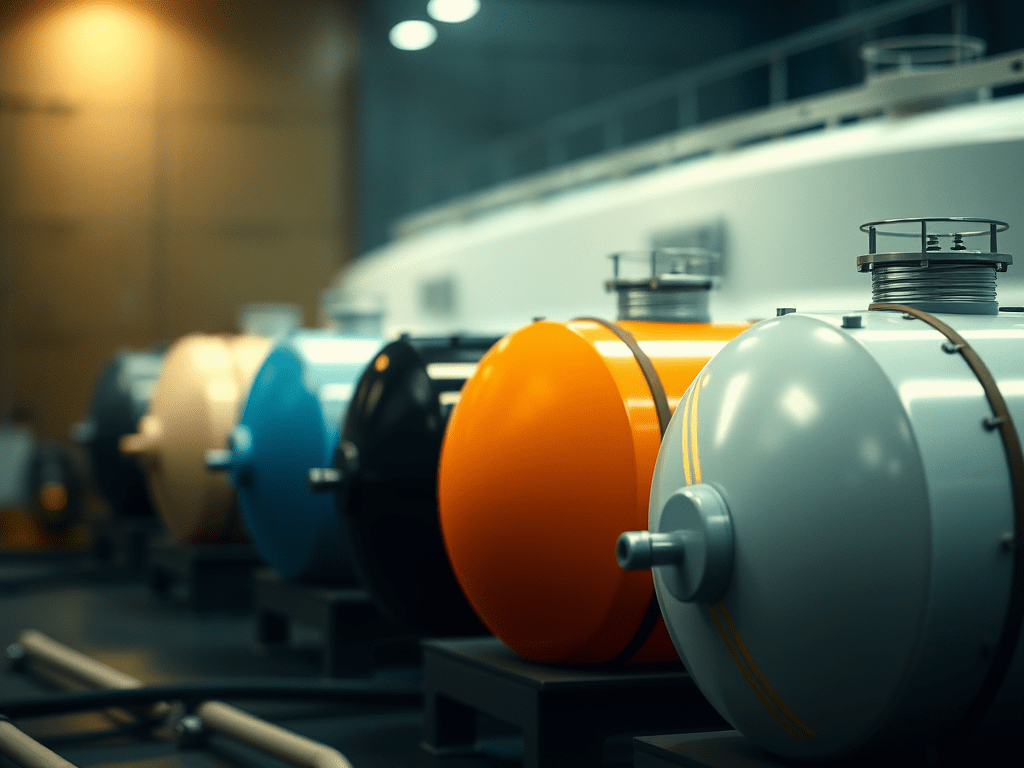
Hydrogen has emerged as a promising energy carrier that could significantly reduce greenhouse gas emissions when paired with fuel-cell technologies. However, the challenge of safely storing hydrogen—an extraordinarily low-density gas—at high pressures has driven substantial research into tank design and materials engineering. In this context, hydrogen storage tanks are classified into five types: Type I (all-metal), Type II (metal liner with composite reinforcement), Type III (thin metallic liner with high-performance composite overwrap), Type IV (polymer liner with composite overwrap), and Type V (fully composite systems). This article reviews the technological principles, material innovations, and manufacturing methods underpinning each tank type, critically comparing their mechanical performance, weight considerations, and suitability for various applications.
2. Overview of Hydrogen Storage Tank Classifications
2.1 Type I Tanks: All-Metal Structures
Type I tanks rely exclusively on metallic materials such as stainless steel or aluminum alloys for containment. Their fabrication typically involves conventional welding, machining, and forging methods. While these tanks offer robustness and excellent hydrogen impermeability, their substantial weight and susceptibility to hydrogen embrittlement under cyclic loading are key limitations. They remain relevant in stationary storage scenarios where weight is less critical and proven reliability is essential.
2.2 Type II Tanks: Metal Liners with Composite Reinforcement
Type II tanks introduce a hybrid approach in which a thin metallic liner—commonly aluminum—is combined with an external composite overwrap. The liner ensures hydrogen impermeability while the composite, typically composed of carbon or glass fibers aligned in hoop directions, provides the necessary tensile strength to sustain high-pressure loads. This design achieves moderate weight reduction relative to Type I systems while mitigating issues of hydrogen degradation in pure metals.
2.3 Type III Tanks: Thin Metallic Liner with High-Performance Composite Overwrap
Further advancements are seen in Type III tanks, where the metal liner is made even thinner, relying on precise filament winding techniques to apply a high-performance composite overwrap. The synergy between the ultra-thin, hydrogen-impermeable liner and the high-tensile composite fibers (predominantly carbon fiber combined with high-performance resin systems) results in significant weight savings and the ability to sustain pressures up to 700 bar. The technological challenge here lies in ensuring uniform composite placement to avoid stress concentrations under cyclic loading.
2.4 Type IV Tanks: Polymer Liners with Composite Overwrap
Type IV tanks mark a paradigm shift by replacing the metal liner with a polymer-based alternative, typically high-density polyethylene (HDPE) or other thermoplastic polymers engineered for hydrogen barrier properties. The polymer liner is produced via blow molding or rotational molding to yield a seamless, lightweight containment layer. Over this, an advanced composite overwrap—often carbon fiber reinforced with an epoxy or thermoplastic resin—is applied, optimizing the weight-to-strength ratio while maintaining high safety standards under high pressures. This configuration not only ameliorates weight but also enhances corrosion resistance and impact performance under variable environmental conditions.
2.5 Type V Tanks: Fully Composite, Linerless Structures
Representing the cutting edge of hydrogen storage technology, Type V tanks eliminate the traditional liner entirely, instead relying on a fully composite architecture. In these systems, the load-bearing and barrier functionalities are integrated into a single composite structure. The design typically employs advanced thermoset or thermoplastic resin systems with pre-impregnated high-strength fibers, such as carbon fiber, and increasingly, nanocomposite additives to enhance barrier properties. The absence of a separate liner reduces overall weight and manufacturing steps but demands innovative solutions to overcome challenges in hydrogen permeability and fatigue resistance. Emerging techniques, including the integration of barrier coatings and nanoparticle reinforcements (e.g., graphene or clay nanoparticles), are critical to ensuring that Type V tanks meet the rigorous performance standards required for high-pressure hydrogen storage.
3. Materials and Composites: Engineering for Performance
The materials utilized in hydrogen storage tanks must reconcile conflicting demands—maximizing strength and hydrogen impermeability while minimizing weight.
- Metals (Types I–III): Stainless steels and specialized aluminum alloys provide durability and resistance to hydrogen permeation. However, the phenomenon of hydrogen embrittlement remains a critical challenge that necessitates either thicker walls (with concomitant weight penalties) or protective composite measures.
- Composites (Types II–V): Carbon fiber composites, prized for their high tensile strength-to-weight ratio, form the cornerstone of the externally applied reinforcement in Types II–IV and the structural base in Type V tanks. Glass fibers offer a cost-effective alternative, albeit with reduced performance metrics. The composition and orientation of fibers, combined with carefully selected resins (epoxy for high chemical resistance, thermoplastics like PEEK for improved toughness and recyclability), allow designers to optimize the stress distribution across the tank wall.
- Polymers: For Type IV tanks, the polymer liner (commonly HDPE) must ensure an impermeable barrier against hydrogen while remaining ductile under cyclic pressure. Advances in polymer science have yielded formulations with improved resistance to crack propagation and fatigue.
- Nanocomposites: In the quest for fully composite (Type V) solutions, the incorporation of nanomaterials such as graphene, carbon nanotubes, or clay nanoparticles into the resin matrix has shown promise in significantly reducing hydrogen permeability and enhancing mechanical properties. These materials not only provide enhanced barrier performance but also contribute to a more uniform stress distribution, reducing the risk of micro-crack formation during pressure cycling.
4. Manufacturing Techniques and Process Integration
The production of hydrogen storage tanks leverages a transition from traditional metalworking processes to advanced composite fabrication and integration technologies:
- Type I Manufacturing: Relies on metal forging, welding, and machining with an emphasis on uniformity and integrity.
- Composite Overwrapping (Types II & III): Filament winding stands as the predominant technique. During this process, pre-impregnated fibers are tensioned and wound around a pre-formed metal liner with precision control over fiber orientation. Such an approach ensures maximum load-bearing capacity in the hoop direction, thus optimizing safety margins at high pressures.
- Polymer Liner Formation (Type IV): Techniques such as blow molding and rotational molding produce seamless polymer liners. These methods ensure a homogeneous interior surface which is critical for reducing stress concentrations that might lead to premature failure.
- Fully Composite Fabrication (Type V): Emerging manufacturing processes like resin transfer molding (RTM) and automated fiber placement (AFP) are under active development. These processes aim to integrate barrier and structural functions within a single manufacturing step while preserving the integrity of the composite matrix. Innovations in robotics and process automation are increasingly playing a role in scaling these fabrication techniques for industrial production.
5. Comparative Analysis and Performance Metrics
A quantitative comparison of hydrogen storage tank types underscores the evolution toward lighter, stronger, and more efficient designs. Consider the following table summarizing the key attributes:
Table 1: Comparative overview of hydrogen storage tank types
| Tank Type | Primary Liner Material | Reinforcement/ Overwrap | Weight Considerations | Operational Pressure | Manufacturing Complexity |
| Type I | Stainless/ Aluminum | None | High | Up to 350 bar | Low |
| Type II | Metal (Typically Aluminu) | Composite (Carbon/Glass Fibers, predominantly hoop winding) | Moderate | 350–700 bar | Moderate |
| Type III | Ultra-thin Metal (Aluminum) | High-performance Composite (Carbon Fiber with Epoxy) | Low | Up to 700 bar | High |
| Type IV | Polymer (HDPE or similar engineered polymer) | Composite Overwrap (Advanced Carbon Fiber Composites) | Very Low | 350–700 bar | High |
| Type V | None (Fully Composite) | Integrated Composite Structure (Advanced thermoset/thermoplastic with nanocomposites) | Ultra-low | 350 bar or higher | Very High |
This progression—from the robust yet heavy Type I tanks to the promise of ultra-light Type V systems—is driven by advances in materials science and composite manufacturing. The ability to sustain high operational pressures while minimizing weight is crucial for mobile applications, particularly in automotive and aerospace sectors, where every kilogram influences performance and energy efficiency.
6. Performance, Safety, and Longevity Considerations
Ensuring the safe operation of hydrogen storage tanks requires rigorous attention to hydrogen embrittlement, fatigue resistance, and potential leak pathways.
- Hydrogen Embrittlement: Metallic components in Type I tanks are prone to embrittlement under rapid pressure cycling. Composite overwraps in Types II and III serve to reduce direct stress on the metal liner, thereby mitigating this risk.
- Interface and Compatibility: In Type IV and V systems, the interface between the polymer or composite layers and the reinforcing fibers is critical. Optimal adhesion and compatibility between materials prevent delamination, a common failure mode under cyclic loading.
- Barrier Enhancement: In fully composite Type V designs, the integration of barrier layers through nanocomposite additives or advanced resin formulations is essential. These strategies are effective in minimizing hydrogen permeation without compromising the overall structural integrity.
- Testing and Evaluation: Comprehensive testing—including rapid decompression, fatigue lifecycle analysis, and non-destructive evaluation (e.g., ultrasonic inspection, thermographic imaging)—is integral to validating design performance and ensuring long-term durability under operational stresses.
7. Future Directions and Emerging Innovations
The evolution of hydrogen storage tanks is likely to continue along the trajectory of materials innovation and smart manufacturing. Several promising avenues include:
- Nanocomposite Enhancements: Ongoing research into graphene-infused resins, carbon nanotube frameworks, and other nanoparticle-enhanced matrices promises to yield fully composite structures (Type V) with exceptional barrier properties and mechanical performance.
- Self-Healing Polymers: The development of self-healing polymer liners or composite matrices that can autonomously repair micro-cracks will significantly extend the operational life and reliability of hydrogen tanks.
- Advanced Simulation and Design: High-fidelity computational modeling techniques are increasingly being used to predict stress distributions and optimize fiber orientations, drastically reducing development cycles and material wastage.
- Structural Health Monitoring (SHM): Integration of embedded sensors to continuously monitor tank integrity in real time can preemptively signal potential failure, thereby enhancing safety protocols across both mobile and stationary hydrogen storage applications.
- Hybrid Manufacturing Techniques: The convergence of 3D printing with advanced composite fabrication methods offers the prospect of bespoke, application-specific tank designs that can be rapidly prototyped and scaled into production.
8. Conclusion
This review has detailed the evolution of hydrogen storage tanks from conventional all-metal designs to sophisticated fully composite systems poised to propel hydrogen energy into mainstream viability. Through an examination of Type I–V systems, we have highlighted the interplay between advanced materials—metals, polymers, carbon fiber composites, and nanocomposites—and innovative manufacturing techniques that together drive improvements in weight efficiency, operational pressures, and overall safety performance.
The future of hydrogen storage is anchored in interdisciplinarity—where breakthroughs in nanotechnology, self-healing polymers, and smart manufacturing converge to overcome the inherent challenges of hydrogen embrittlement and permeability. As the demand for sustainable energy solutions grows, the ongoing advancements in hydrogen storage technologies will be indispensable in ensuring that hydrogen serves as a clean, efficient, and reliable energy carrier for decades to come.
Also See

 Adeerus Ghayan