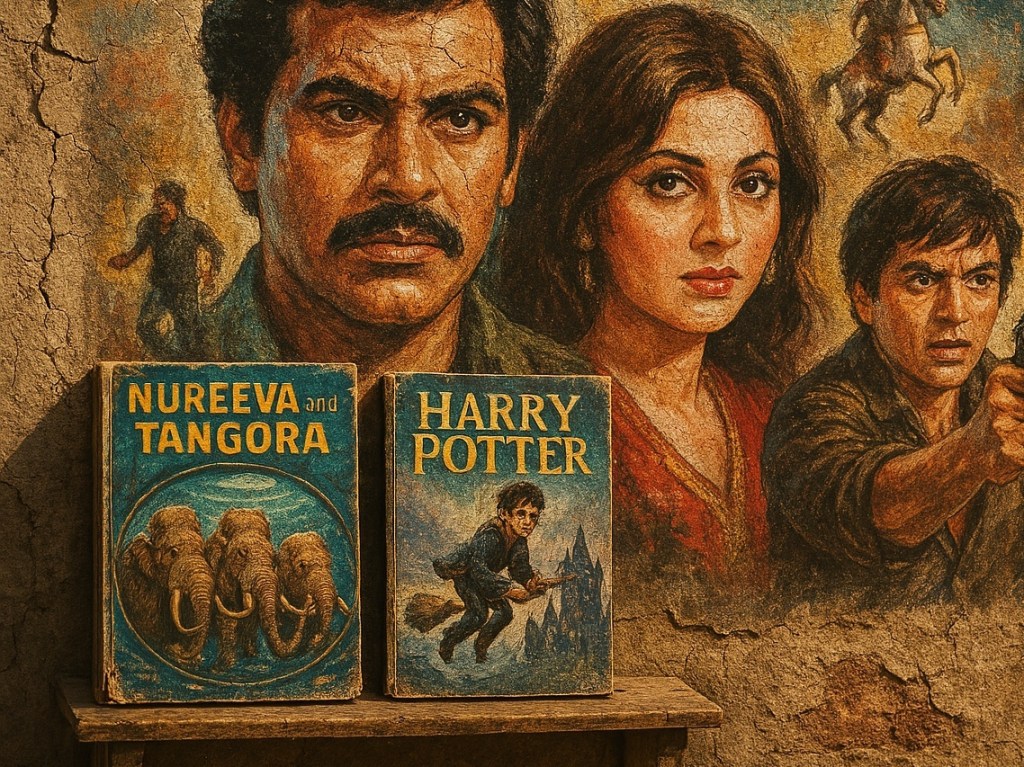
Let’s start with Harry Potter—and why I’ve never connected with it. No, it’s not because of politics or worldview. As both a reader and a writer, I find the “Chosen One” trope inherently limiting: it places narrative weight on destiny rather than earned growth, often sidelining the complexity of character development. Sympathy built through orphanhood or superficial disabilities feels manipulative when those traits don’t meaningfully shape the plot or influence the protagonist’s decisions. I prefer stories where emotional depth arises from lived experience, not narrative shortcuts. For me, authentic character arcs matter more than mythic framing.
This is the most fundamental difference between Nureeva and Harry Potter. While Nureeva and Tangora may be classified as fantasy due to their tone and setting, they are, at their core, hard science fiction. Every element in the story is grounded in sound scientific principles—a demanding but essential foundation, given the complexity of the world being built. On the surface, Nureeva may resemble Harry Potter through its focus on a group of children, a fantastical school, hidden mysteries, and larger-than-life characters. But beneath that, it’s driven by realism, systems logic, and emotional authenticity.
I know saying “everyone enjoys it” might sound like a stretch, but so far, I haven’t encountered a detailed critique that dismantles the story. If one’s out there, I’d genuinely love to read it. Thoughtful criticism is always welcome—because that’s what helps me write better books.
Now, why do people enjoy it? It’s no secret. Every writer knows—and those who plan to be one will soon learn, perhaps through AI chats if nothing else—that a compelling story needs three things: characters we fall in love with and want to root for (the emotional component), intellectually engaging writing with coherent logic and narrative complexity, and finally, creativity—the unique style of the author.
While character development and narrative structure can be honed through hard work, creative style is something deeply personal. It’s shaped by the writer’s ideologies and lived experiences, and when others try to imitate it, it often falls flat. One example of this is the selection of character types. In Harry Potter, nearly every character is white—not because the author is racist, but because the story reflects her lived experience. Nureeva and Tangora also take place in a Western country, but my lived experience is that of an immigrant. That reality is baked into the story. My creativity naturally includes characters from diverse backgrounds. It may seem like a small detail, but it has a meaningful impact. Imagine if Harry Potter had students from a wide range of regional and cultural backgrounds—the entire plot would need to shift to maintain coherent worldbuilding.
To be clear, I’m not suggesting Harry Potter should have included every kind of person. Doing so would have broken the internal logic of its world. This is simply a reflection of creative style.
Another example of my creative approach is the inclusion of real-world events—like COVID-19—as devices to move the plot forward. I use them for several reasons: they help anchor the story in time without explicitly stating a date, and they allow me to bypass the need to explain how society would respond to such an unknown event.
One final aspect of my creative style is that my characters are built in stone—they do not change. I know this goes against conventional wisdom, where character arcs are considered fundamental. But in my stories, including Nureeva and Tangora, characters neither evolve nor transform the world around them. That’s the point. It’s part of my creative DNA.
There’s a lot more I want to share in upcoming videos, but for now, I’d love to hear what you think. Does this make the story compelling—or too static? I’m genuinely curious.
Also See
Flawless to Flawed Spectrum of Fictional World Building in Novels and Media
Best Opening or First Lines of My Novels
Harry Potter Isn’t the Blueprint: Why Nureeva and Tangora Stands on Its Own

 Adeerus Ghayan