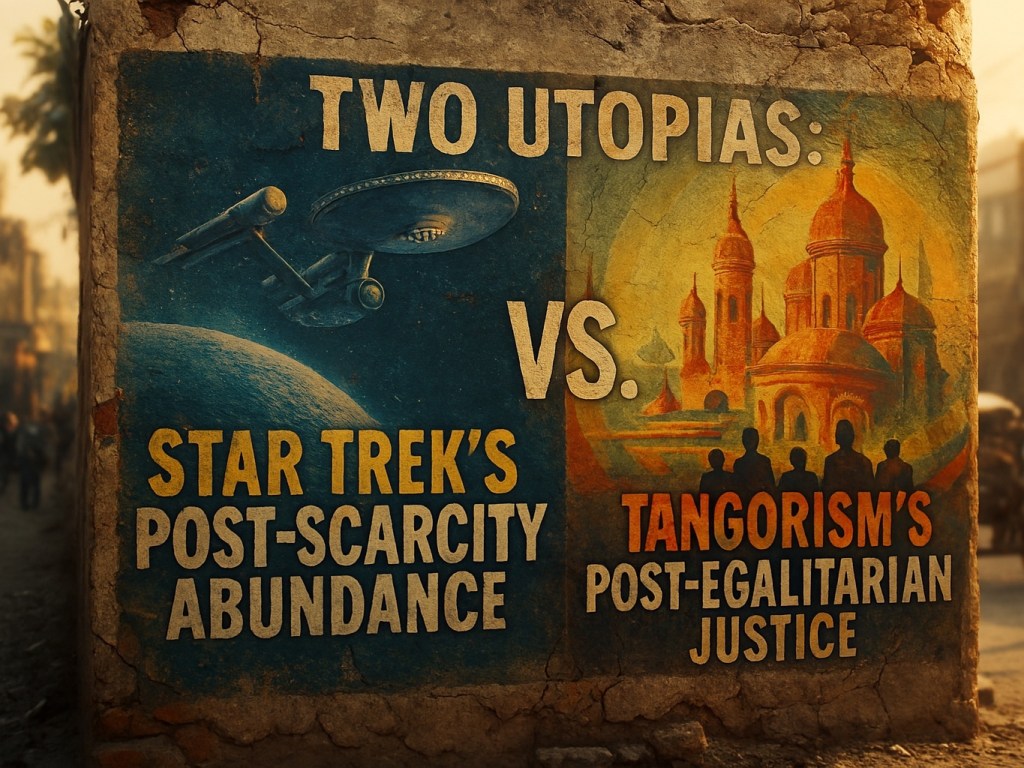
Contemporary speculative fiction offers fertile ground for examining competing visions of utopia—each reflecting distinct philosophical, economic, and cultural assumptions. Here two such frameworks are explored: the post-scarcity paradigm exemplified by Star Trek, and the post-egalitarian philosophy of Tangorism, as articulated by Akumoh and Hyzoria in Adeerus Ghayan’s Nureeva and Tangora. While Star Trek imagines a future liberated from material constraints through technological abundance and moral aspiration, Tangorism proposes a more emotionally resonant and symbolically rich alternative—one that transcends both capitalist and communist logics in favour of equitability, cultural plurality, and mutualistic design.
By juxtaposing these two models, this analysis interrogates the implicit values embedded within utopian narratives: What constitutes freedom in a post-scarcity world and post-egalitarian world? And how might symbolic infrastructure and emotional depth reshape our understanding of justice and belonging?
The Star Trek universe has long stood as a beacon of utopian imagination in science fiction. Set in a post-scarcity future, it envisions a society where hunger, poverty, and the pursuit of wealth have been transcended. The United Federation of Planets—a cosmopolitan alliance of worlds—promotes liberty, justice, and peaceful coexistence. Citizens work not for survival, but to better themselves—and humanity. Technology enables exploration, creativity, and diplomacy, while social structures appear egalitarian and inclusive.
Yet beneath this optimistic veneer, Star Trek’s utopia remains subtly constrained. Its society, while post-capitalist, still leans on a utilitarian ethos: individuals are expected to contribute according to their abilities, but emotional nuance, cultural diversity, and symbolic depth are often flattened into a uniform Federation identity. The system assumes a shared moral compass and cultural coherence— which can obscure real differences, and suppress radical pluralism. Conflicts with alien species often reveal the Federation’s discomfort with true otherness, suggesting that its inclusivity is conditional, and its harmony somewhat homogenized.
Tangorism, by contrast, offers a more emotionally resonant—and philosophically rigorous—alternative. Tangorism, pioneered by Akumoh and Hyzoria in Adeerus Ghayan’s Nureeva and Tangora, responds to the limitations of both capitalism and communism by envisioning a more humane alternative. It proposes a “third economic system,” rooted in equitability— where resources and opportunities are tailored to individual needs, rather than distributed uniformly. It transcends egalitarianism’s emphasis on equal distribution, recognizing that true justice lies in designing systems that honour difference—without hierarchy or exclusion.
Where Star Trek relies on technological abundance and moral aspiration, Tangorism integrates infrastructure with emotional and symbolic richness. Hyzoria’s contributions ensure that Tangorism is not merely functional—but culturally alive. Citizens enjoy work-life harmony, creative autonomy, and access to fantastical technologies— not as passive beneficiaries, but as active participants in a reciprocal social contract. The Tangorist code of conduct calls for empathy, contribution, and communal responsibility— fostering a society where well-being is interdependent, and shared.
Unlike Star Trek, which often treats utopia as a backdrop for adventure, Tangorism treats it as a lived philosophy. It challenges isolationist individualism, and reimagines the individual journey as a mutualistic path— where each person’s flourishing is bound to the collective good. It dares to ask: What if science, art, and equity could converge to build a better world—not for some, but for all?
In the end, Star Trek offers a compelling vision of what humanity might achieve when freed from material constraints. But Tangorism goes further. It does not merely eliminate scarcity—it redefines value. It does not just imagine peace—it designs belonging. It is not just a better system; it is a deeper story.
Also See

 Adeerus Ghayan